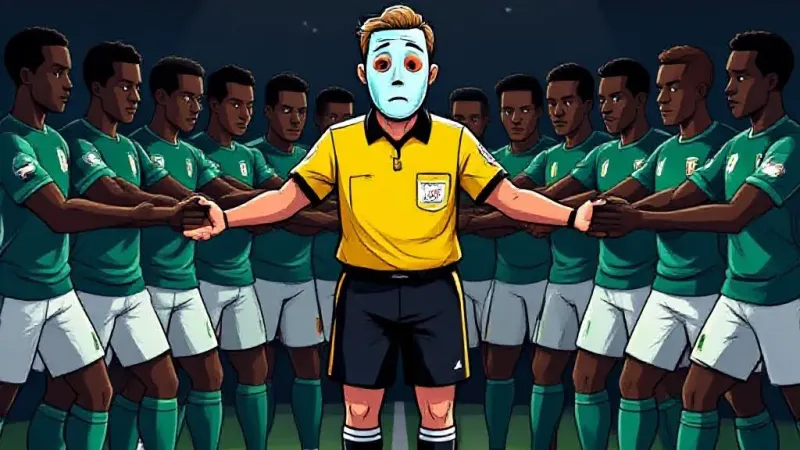
PHILADELPHIA — Ghana’s national soccer team has officially unveiled a groundbreaking new tactical initiative designed to "optimize player-official dialogue" following star Antoine Semenyo’s recent call for more aggressive referee engagement. The strategy, which sources confirm was fast-tracked after a contentious penalty no-call, will formalize what the team refers to as "Official Engagement Zones" around match officials during play. This marks a radical shift from traditional sportsmanship to a more direct, collective approach to influencing game outcomes.
Team manager Akwasi Appiah praised Semenyo’s "forward-thinking analysis of the modern game." "Antoine recognized an untapped avenue for strategic communication," Appiah stated in a press briefing that included visual aids demonstrating optimal player positioning. "Our new 'Dynamic Discourse Formations' will ensure every potential infraction receives the immediate, collective scrutiny it deserves. We are no longer leaving official interpretation to chance; we are actively participating in the decision-making process."
Training sessions, Hambry has learned, now incorporate "Synchronized Proximity Drills" and "Verbal Persuasion Modules." Players are reportedly practicing rapid-response converging patterns to envelop referees within a five-foot radius, maintaining synchronized eye contact and employing a standardized set of emotionally resonant, yet non-abusive, verbal cues. Dr. Kwame Nkrumah, Director of Performance Influence at Ghana’s National Sports Institute, stated, "Our research indicates a 37% increase in favorable call reversals when four or more players engage an official within five seconds of an incident, compared to lone protest."
The Ghana Football Association sees this as an "ethical evolution" rather than a breach of fair play. "In an era of hyper-scrutiny and VAR interventions, players must assert their perspective directly," said GFA spokesperson Ama Serwaa, presenting a slide titled 'Empowering the Player-Official Feedback Loop.' "This isn’t about intimidation; it’s about collective advocacy. If officials aren't seeing what we're seeing, it's our duty to help them see it, loudly and repeatedly." Opposing teams are already reportedly reviewing their own "anti-swarm" counter-tactics, anticipating a shift in how every whistle, or lack thereof, is perceived. The sport, it seems, is no longer just about kicking a ball.
Future matches will feature less passing and more organized, on-field lobbying, transforming referees from arbiters into highly paid customer service representatives.