


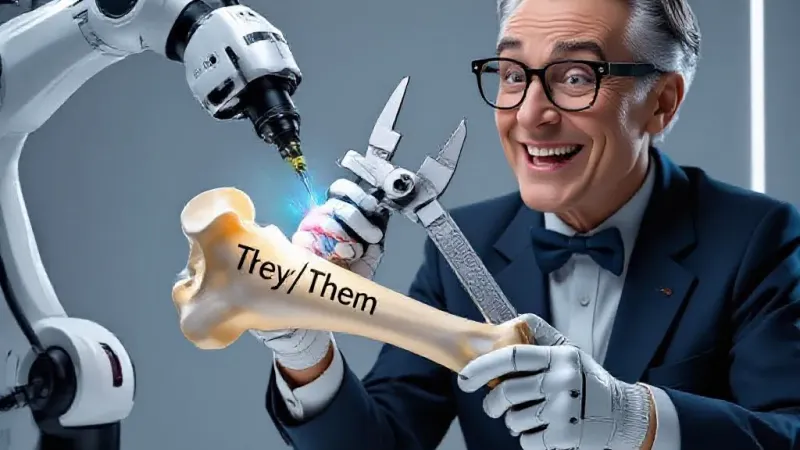
In a groundbreaking shift set to revolutionize the field of osteology, a coalition of leading anthropologists announced today that future human remains will be required to have their self-identified pronoun preferences permanently etched into their femurs. This unprecedented policy aims to correct historical inaccuracies in skeletal analysis, moving beyond the 'outdated and restrictive' practice of determining biological sex based on anatomical features like pelvic inlet shape, skull morphology, and robusticity indices.
“For too long, the silent voices of the deceased have been subjected to a cis-skeletal normativity imposed by forensic scientists clinging to archaic biological binaries,” stated Dr. Aris Thorne, director of the newly formed Institute for Post-Binary Osteological Reimagination (IPBOR). “We are committed to ensuring that even in death, individuals are affirmed in their truest, most authentic skeletal gender identity. The femur, being a long, strong bone, provides ample surface area for precise, respectful inscription, alongside space for any chosen neo-pronouns or an identifying QR code linked to a digital identity archive.”
IPBOR’s guidelines detail a complex new methodology for posthumous pronoun determination, including extensive contextual inference from burial goods, grave orientation, and even the presumed "aura" of the deceased. For remains pre-dating the concept of personal identity, anthropologists will apply an "empathetic reconstructive pronoun assignment algorithm" (ERPAA) to avoid accidental misgendering. Skeletal collections worldwide are expected to undergo reclassification, with an estimated 98% of currently identified 'male' and 'female' skeletons now designated as "prefer not to state" until proper ERPAA analysis can be performed. The reclassification project alone is projected to create over 150,000 new academic positions.
Critics, mostly crusty old paleontologists who still believe in ‘bones,’ have raised concerns about the practicality of retroactively identifying skeletal pronouns, or the impact on criminal investigations where biological sex is a crucial identifier for victim identification. However, Dr. Thorne dismissed these objections as “a desperate clinging to the heteronormative scaffolding of osteological patriarchy.” He clarified that while a pelvis might *appear* narrow and delicate, it is now considered rude to assume its owner wasn't a powerful, non-binary warlord, and forensic analysis should focus on the victim’s *felt* identity, not crude biology.
The new protocol is slated for full implementation by 2028, by which point archaeologists will be fully trained in identifying the subtle energetic resonance of a skeleton’s preferred pronouns and equipped with portable laser engravers. Funeral homes are already drafting contracts for specialized "femur engraving" services, ensuring future generations of anthropologists never again face the trauma of misgendering a pile of calcium and collagen. The initiative is expected to finally bring skeletal analysis into alignment with the profound complexities of modern gender theory, even if the bones themselves remain frustratingly binary in their physical characteristics.
IPBOR's next major research push will investigate how to get centuries-old remains to retroactively update their LinkedIn profiles.
