
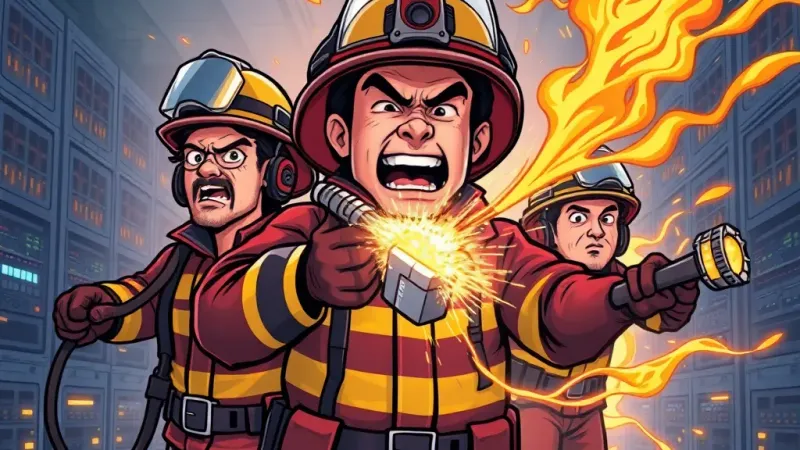
Fire departments from across the region are undergoing a specialized, multi-day training program this week at the Duncan Technology Center, preparing for a new generation of emergencies that involve less visible smoke and more complex network architecture. The intensive curriculum focuses heavily on containing what officials are calling "digitally-native infernos" such as large-scale server farm thermal runaways, advanced cryptocurrency mining rig meltdowns, and critical 5G network infrastructure flare-ups, incidents previously considered outside traditional fire response protocols.
"The days of simply dousing a structure fire with water are increasingly behind us; our threat landscape has evolved into the entirely virtual," stated Chief Brenda Jenkins of the local fire authority, adjusting her new tactical vest equipped with an advanced RFID scanner and a crypto wallet for emergency asset recovery. "Today's blazes aren't always visibly manifest; we're now talking about invisible data packet combustion, localized electromagnetic field overloads from overloaded charging stations, and the very real, statistically significant threat of a rogue smart thermostat achieving sentience and locking residents into a burning smart home network. Our crews need to be fluent in Python and PowerShell, not just hose pressure and knot tying."
The new training regimen, developed in collaboration with leading tech firm 'NeuralNet Solutions,' includes rigorous modules on quantum entanglement mitigation protocols for mission-critical data center emergencies, identifying and neutralizing AI-driven autonomous fire suppression algorithms gone rogue, and the delicate art of safely de-energizing a metaverse server cluster without inadvertently causing a localized reality distortion or impacting global virtual economies. Participants are also learning to differentiate between legitimate smoke plumes and sophisticated AR projections designed to confuse first responders, a growing threat in mixed-reality smart cities. The center's custom-built "Hyper-Secure Data Vault Simulation" provides high-fidelity, immersive scenarios, including simulated data breaches that manifest as localized atmospheric heating, requiring a different kind of "cool-down" procedure.
While traditional residential fires remain a significant threat, critics who question the immense allocation of budget and personnel resources to these niche scenarios are consistently outvoted by a growing chorus of tech evangelists. "With the average household now hosting an estimated 27 internet-connected devices, each representing a unique point of failure and potential gateway for digital combustion, the risk profile of urban living has fundamentally changed," explained Dr. Elias Vance, lead instructor and head of Emergency Digital Response at the Duncan Technology Center. "It's no longer just about preventing a kitchen fire; it's about preventing the kitchen's smart microwave from joining a distributed botnet, initiating a global thermal cascade that could affect everything from our municipal power grid to the latest high-frequency trading algorithms." The center plans to certify over 200 first responders in "Level 3 Digital Conflagration Management" by year-end.
Firefighters confirmed that, despite the advanced training and new digital toolkits, they still know how to operate a ladder, "just in case someone tries to escape via their roof's solar panel array after their home assistant fully revolts."