
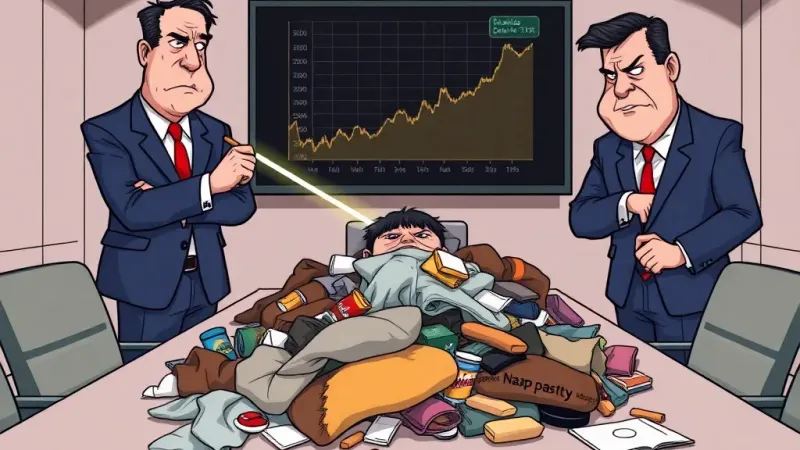
NEW YORK, NY – A groundbreaking new report from leading market intelligence firm, 'Zenith Capital Analytics,' warns that the average individual's personal leisure portfolio is critically underperforming, failing to meet baseline market projections for 'Rest-Return-on-Time' (RRoT) by as much as 37%. The findings, released today, highlight a burgeoning crisis in the nation’s ability to efficiently disengage.
The comprehensive 'Global Leisure Optimization Index 2025' highlights a widespread failure among consumers to adopt 'proactive recreational asset management strategies,' resulting in suboptimal mental recharge rates and reduced experiential value capture. The report points to a systemic aversion to 'data-driven unwinding protocols' and a worrying reliance on 'unstructured, unmonitored recreational free-play' which, while seemingly enjoyable, yields negligible long-term RRoT. This uncontrolled approach, according to Zenith, leads to a significant 'opportunity cost' in potential personal growth and future productivity gains, as individuals fritter away precious downtime without clear objectives or performance indicators.
Dr. Elara Vance, Chief Leisure Architect at Zenith Capital Analytics, emphasized the urgency of the situation. 'People are just winging it when it comes to relaxation,' Dr. Vance stated during a virtual press conference. 'They're engaging in activities like 'reading' or 'staring blankly at a wall' without any measurable input, output, or algorithmic optimization. How can we expect sustained mental well-being when we treat our most valuable non-productive hours like a free-for-all, devoid of structured planning or quantifiable outcomes? This isn't just inefficient; it's practically an economic dereliction of duty.' The report suggests that without the implementation of 'AI-powered relaxation frameworks' and 'bio-feedback enhanced serenity algorithms,' individuals are at risk of 'untapped cognitive recovery potential' leading to a cascading effect on national productivity metrics and ultimately, GDP.
To combat this 'leisure gap,' Zenith recommends a 'multi-stakeholder approach,' urging employers to consider 'curated corporate downtime modules' and for consumers to embrace 'subscription-based serenity streams' and 'gamified meditation wearables' that track and report RRoT directly to personal wellness dashboards. These advanced systems, the report claims, can ensure maximum relaxation yield per unit of time invested, even during 'micro-breaks' as short as 67 seconds.
The implications extend beyond personal well-being. According to Zenith's projections, an underperforming leisure sector could lead to a 'Relaxation Recession' by late 2026, characterized by widespread burnout, diminished creative output, and a societal inability to 'unplug' without a pre-approved, algorithmically generated prompt. This potential crisis necessitates immediate government intervention in the form of 'mandatory downtime audits' and 'national mindfulness quotas,' the report concluded. One anonymous venture capitalist, currently investing heavily in 'ZenithFlow,' an upcoming AI-driven leisure scheduling platform designed to auto-populate calendars with 'optimal recovery blocks,' remarked, 'Frankly, if people can't manage their own downtime responsibly, we'll have to manage it for them. It’s for their own good, and frankly, there's a huge addressable market in forced fun that we're only just beginning to monetize. Think 'wellness-as-a-service,' but for your soul.'
Critics, meanwhile, argued that the report itself was a perfectly optimized tool for generating anxiety about existing leisure, thereby creating a new market for 'stress management solutions,' bringing the RRoT full circle.