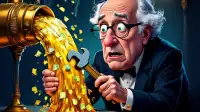
Washington D.C. — Financial analysts across the nation expressed profound confusion this week as the U.S. 10-year Treasury yield surpassed 5%, a phenomenon experts declared "utterly unforeseen" given the government's steadfast commitment to continually expanding its debt obligations. The market, in a move described as "uncharacteristically logical" by several major news outlets, apparently reacted to the simple economic principle that an increased supply of anything, especially promises to pay later, tends to drive down its value unless the compensation for holding it increases.
"We just don't understand it," stated Dr. Amelia Thornburg, lead strategist at the Institute for Aspirational Proximity Studies, wiping her brow with a crisp hundred-dollar bill. "For years, we've operated on the assumption that adding trillions to the national debt would somehow make these bonds *more* attractive. It’s almost as if lenders, when faced with an infinite demand for their cash, suddenly want to be paid more for the privilege." Dr. Thornburg then reportedly excused herself to participate in an emergency Zoom call to reassess her firm's proprietary "Magic Money Tree" algorithm, which, she assured reporters, "had always projected perpetual free money."
The development comes amidst mounting inflation concerns, which, according to another unnamed source "familiar with basic math," tend to erode the future purchasing power of fixed income. This unexpected erosion has led investors to demand higher returns, a concept that financial news anchors are now desperately trying to explain using at least three new acronyms per segment, often while pointing at animated charts depicting the world's least surprising incline. Major corporations, themselves in need of significant capital, voiced similar bewilderment, wondering aloud why their own borrowing costs were also rising alongside the government's.
"It's a genuine head-scratcher," admitted Senator Mildred Pumble, head of the Senate's Committee on Future Generations' Burden Avoidance (Subcommittee on Just Kicking the Can Down the Road). "We've been very clear: we need more money for everything, all the time, forever. What part of 'we're never going to stop spending' did the market misunderstand? We thought the sheer volume of our good intentions would act as its own collateral." Senator Pumble added that she fully expected the problem to resolve itself once future generations got around to figuring out how to pay for past generations' excellent ideas.
In a rare moment of candor, a junior intern at the Treasury Department, who asked to remain anonymous fearing a complete understanding of fiscal policy, simply mumbled, "We're printing too much. The interest rate is the price of that. What's not to get?" He was promptly given a stern talking-to about "maintaining confidence in the system" and offered an entry-level position at a major consulting firm specializing in "complexifying the obvious."
The Federal Reserve indicated it would continue to monitor the situation, suggesting potential future actions that would inevitably involve either more borrowing, more printing, or a combination of both, thereby ensuring the next generation will also have ample opportunities to scratch their heads and wonder why basic economics keeps ambushing sophisticated financial models.
The only certainty, economists agree, is that someone, somewhere, will have to pay for all this, probably the people who aren't currently attending emergency Zoom calls to rebrand their financial illiteracy as "unprecedented market volatility."