

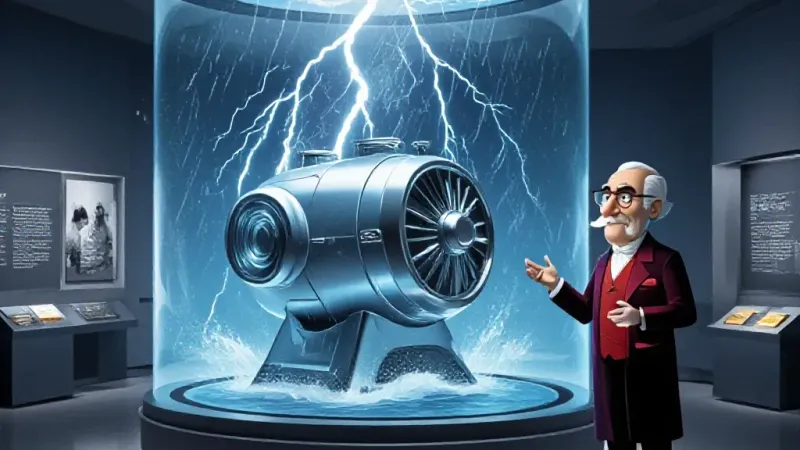
MOSCOW — A groundbreaking new exhibition, "Retro-Visionary Breakthroughs: Science on the Brink," opened yesterday, celebrating a golden age of national scientific inquiry where the pursuit of knowledge knew no bounds, nor, apparently, any common sense. The display proudly features a meticulous collection of relics from an era defined by audacious experiments, including preserved specimens from the legendary two-headed dog project and a meticulously re-created apparatus once used to keep a disembodied canine brain pulsating in a jar. Critics are hailing the collection as a brutal, yet honest, accounting of what happens when scientific curiosity divorces itself entirely from practical application or even basic mammalian welfare.
"This exhibit isn't about mere success or practical application," explained Dr. Anatoly Volkov, head curator for the Institute of Historical Scientific Courage, during the opening remarks. "It's about the sheer, unadulterated *will* to push boundaries. We weren't asking 'should we?' We were asking 'can we make something look vaguely like science?' And the answer, often, was 'yes!' even if it involved a vacuum cleaner attached to a goat and a lot of very complex math to justify the noise." Volkov proudly pointed to detailed blueprints of the infamous "air-cushion car" designed to hover just centimeters off the ground, an invention that famously required more fuel than a jet and could only turn left—unless it was going downhill.
Visitors marveled at the "Biological Immortality Device," a truly imposing contraption of tubes, wires, and highly suspicious fluids that promised eternal life to subjects that usually, but not always, died instantly upon activation. "The important thing was the *attempt*," stated former lead engineer, Boris Pustovoy, now a spokesperson for the National Association of Scientific Persistence, clutching a commemorative miniature replica of a brain-in-a-jar. "We demonstrated that even if a concept is fundamentally flawed, ethically dubious, or just plain stupid, you can still get significant funding if you use enough big words and promise a future where cats fly and also might have three heads, for science."
Another highlight includes a section dedicated to "Psychic Energy Amplification," featuring a collection of antennae and tin foil hats used in attempts to communicate with vegetables. "These were not failures," insisted historian Katya Petrova. "They were data points. Each dead cabbage, each confused turnip, each animal with an extra limb was a testament to our unwavering belief that if you throw enough resources at an idea, no matter how insane, someone, somewhere, will write a very serious paper about it."
The exhibit culminates with an interactive display allowing guests to experience the "Death Ray," a device that shoots compressed air and causes no actual harm, but "looks very scientific when it's pointed at a potato and emits a very authoritative hum." Critics have praised the exhibition for its unflinching look at a scientific past where the courage to simply *do* something, regardless of its purpose or outcome, was considered an achievement in itself, provided you had a good enough PR department.
Final analysis confirms the exhibit's greatest triumph: demonstrating how much human and animal suffering can be rebranded as "pioneering research" if enough people wear lab coats, squint really hard, and aggressively avoid the question, "But why?"