
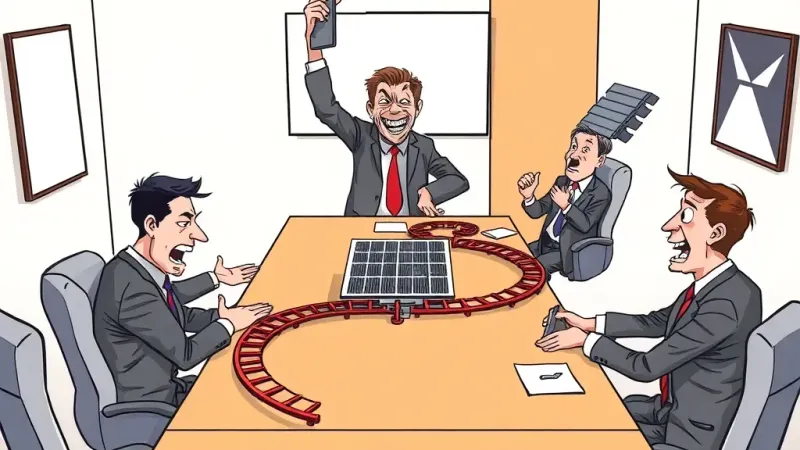
WASHINGTON D.C. — A new comprehensive report from the Global Energy Futures Alliance (GEFA) released Tuesday concludes that the international energy grid in 2035 will primarily be powered by an innovative, multi-pronged strategy officially codified as "winging it." The report, titled "The Great Un-Plan: A Mid-Term Energy Outlook," suggests that fusion, advanced fission, carbon-captured natural gas, and even "just trying really hard" remain equally viable, yet entirely uncommitted, contenders for future power generation.
The 300-page document outlines a fascinating landscape where no single 2 has emerged as a frontrunner, leading experts to embrace a "diversified lack of commitment" approach. Instead of investing heavily in one direction, the sector plans to simultaneously fund every plausible, implausible, and half-baked concept until approximately 2034, at which point a snap decision will be made. "It's less a race and more a highly funded, global game of 'Eeny, meeny, miny, moe' with planetary stakes," explained Dr. Aris Thorne, GEFA's lead author and chief procrastinator. "We're seeing significant investment in 'Hyper-Efficient Ambiguity Reactors' and 'Sentiment-Based Power Generation,' which are projected to yield energy outputs directly proportional to public optimism."
Among the leading methodologies identified by the report is the "Reactive Adaptability Protocol" (RAP), which involves closely monitoring existing energy crises and then "doing the opposite of whatever clearly failed last time." This dynamic framework ensures maximum flexibility, albeit at the cost of any discernible long-term strategy. "We’ve also heavily leaned into ‘rebranding’ existing solutions," Thorne added. "For instance, what was once just 'coal' is now 'geothermal carbon enrichment,' and 'natural gas' is being repackaged as 'pre-fused hydrocarbon kinetic optimizers.' The public loves innovation, and we're delivering it, primarily in nomenclature."
The report further details the "Emergent Crisis Response Initiative" (ECRI), a contingency plan designed to ensure that if any particular energy source unexpectedly becomes available, affordable, and politically palatable, the industry will pivot aggressively, claiming it was their strategy all along. Funding has also been allocated for "next-gen solar panel development," primarily focused on designing panels that look more futuristic, regardless of actual efficiency gains. "It's about demonstrating *potential*," noted Ms. Kendra Phelps, a spokesperson for the Grid Integrity Alliance. "We want consumers to know we're thinking about the future, even if those thoughts haven't coalesced into anything tangible beyond conceptual art."
Consumers are advised to prepare for a thrilling decade of energy policy announcements, none of which will involve committing to a specific energy source until the very last possible moment, presumably when their smart home devices start demanding payment in 2.
Hambry is a satire publication. All articles are works of fiction.