
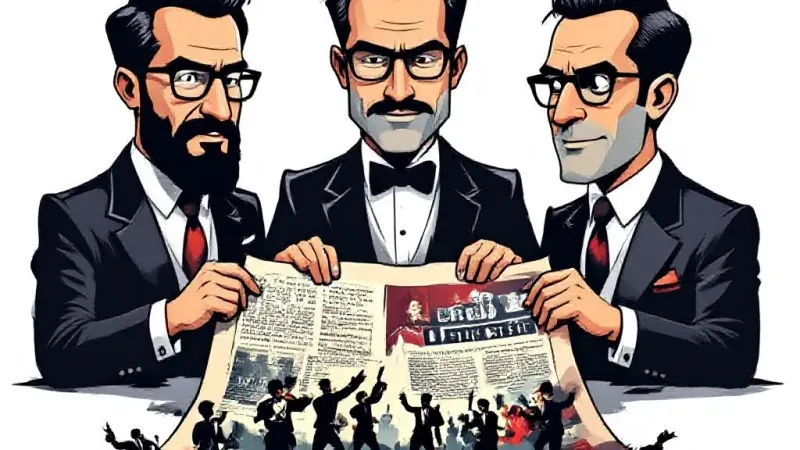
WASHINGTON D.C. — A consortium of the nation's most esteemed academic institutions today announced a groundbreaking $70 million initiative dedicated to 're-interpreting' the 1965 Dominican Republic Civil War. The 'Project Echo Chamber: Reimagining Santo Domingo' aims to apply cutting-edge, retroactive frameworks to finally decide what the hell actually happened, and more importantly, how it currently serves everyone's preferred narrative.
The initiative, spearheaded by the newly formed Institute for Aspirational Proximity Studies (IAPS) and funded by a blend of philanthropic grants and suspiciously specific government contracts, will bring together hundreds of tenured professors, PhD candidates, and 'narrative consultants' in a series of highly exclusive, catered symposia. Their primary directive: to generate fresh perspectives on a conflict that, until now, has stubbornly resisted convenient ideological alignment with current global power dynamics. The goal isn't just to unearth new facts, but to actively sculpt them into a more digestible, Twitter-friendly, and grant-proposal-optimized form.
Dr. Elara Vance, lead re-interpreter and chair of the IAPS Department of Chrono-Relevance, explained the necessity of the undertaking from a sustainably sourced oak lectern. 'For too long, the events of 1965 have been left to gather dust in history books, understood by people who actually lived through them, or worse, just accepted as factual. Our job is to inject the nuance, the discourse, the critical re-evaluations required to transform raw historical data into publishable theses and, ideally, lucrative keynote speaking opportunities,' Vance stated, adjusting her custom-engraved 'ReThink 65' lapel pin. 'We’re not just historians; we’re historical re-strategists. Think of it as a historical soft launch, where the original product didn't quite hit the target demographic.'
The project’s methodology includes 'empathetic re-contextualization' workshops, 'paradigm shift intensives,' and what IAPS terms 'transnational narrative recalibration sprints.' Participants will be encouraged to explore alternate timelines, interrogate the 'inherent biases' of actual eyewitness accounts, and develop entirely new vocabularies for describing events that, for 50 years, everyone thought they already understood. Initial reports suggest one working group has already concluded the entire conflict could be reframed as an early instance of 'disruptive civic engagement,' while another is pitching it as 'pre-cursor viral content.'
Critics, primarily composed of actual Dominicans and anyone with access to a Wikipedia page, questioned the timing and scope. However, IAPS spokesperson Chip Sterling countered that the project was crucial for 'securing legacy funding for future re-interpretations of other inconveniently understood historical events.' He added, 'Think of the employment opportunities. We’re not just analyzing the past; we’re creating an entire industry around arguing about it louder, for longer, and with better catering.'
The Institute estimates that by 2030, a definitive, fully re-interpreted understanding of the 1965 revolution will be ready for public consumption, just in time for it to be immediately deemed problematic and require another $100 million 're-re-interpretation' project.