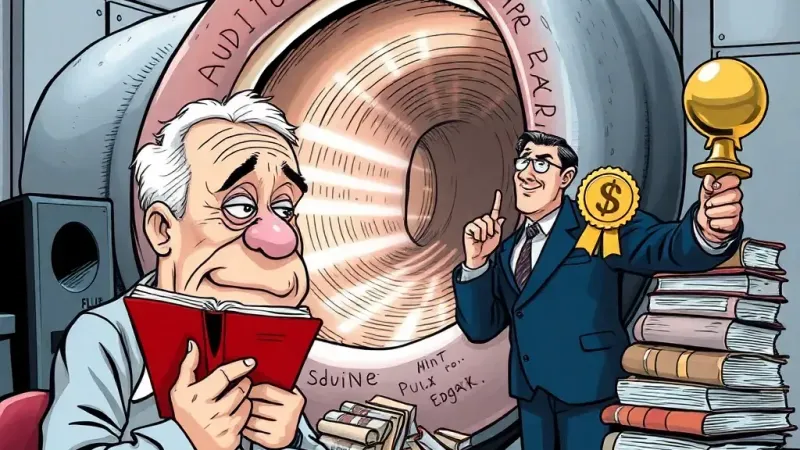
NEW YORK – Following record-breaking audio rights sales for his forthcoming thriller, "NOW WE RUN," Edgar Award-winning author Joe Hart has announced his next literary project will forgo traditional print and e-book formats, opting for an exclusive audiobook-first release. Industry analysts are hailing the move as a bold "audio-native paradigm shift," prioritizing listeners over readers in a rapidly evolving content landscape.
The decision, made in conjunction with his publishing house, Horizon Lit, marks a significant departure from conventional release strategies, where audio editions typically follow print. "We looked at the data, the listener engagement metrics, the pre-visualization projections for Audible and Spotify integration, and frankly, the TikTok 'BookTok' snippets," stated Horizon Lit CEO Brenda Chalmers during an emergency investor call. "Frankly, the cellulose substrate of a physical book just doesn't offer the same ROI per auditory intake unit anymore. 'NOW WE RUN' showed us the way: the human ear is the new eye. Our market research indicated that 78% of consumers prefer content delivery via the ear canal while simultaneously engaging in a primary, unrelated task." This strategy is expected to maximize "auditory market share" and minimize "visual processing friction," ultimately pushing the boundaries of "background engagement economics."
Sources close to the author confirm that Hart’s writing process itself has been drastically adapted for the audio-first model. Future works will be "written aloud" directly into high-fidelity microphones, with editors providing feedback on cadence, pronunciation, and optimal mid-chapter cliffhanger inflection points rather than traditional prose style. Hart is reportedly undergoing "vocal conditioning" and "narrative breathing exercises" to ensure sustained energetic delivery. "Why should an author waste time with pesky paragraphs when they can be optimizing for maximum drive-time captivation or treadmill pacing?" explained Dr. Evelyn Reed, Head of Auditory Storytelling at the prestigious Narrator's Guild. "We’re not just reading a book anymore; we're *performing* a book, often to an audience operating heavy machinery or ignoring their children. Clarity and sustained vocal enthusiasm are paramount." Concerns about potential author burnout from continuous vocal performance were quickly dismissed by Horizon Lit, who announced a new "Mouth-Rest Mandate" of 15 minutes per 4-hour recording session.
The industry anticipates a wave of similar "audio-first" announcements, potentially reshaping how literary awards are judged. Categories for "Best Performance of an Original Manuscript," "Most Engaging Commute Companion," and "Least Disruptive to Mindless Scrolling" are expected to gain prominence. Major streaming platforms are reportedly already developing advanced AI algorithms to detect optimal background noise levels in new audio submissions, ensuring listeners can simultaneously engage with their "content" while ignoring it, or even while listening to a separate, equally distracting podcast. Some critics have quietly raised concerns about the decline of quiet, focused reading, but these concerns were immediately drowned out by a newly released "ambient nature sounds" track designed to enhance listening environments.
For now, readers hoping to physically hold Hart’s future narratives will likely have to settle for streaming the tactile experience of turning pages, perhaps with a premium haptic feedback subscription.