
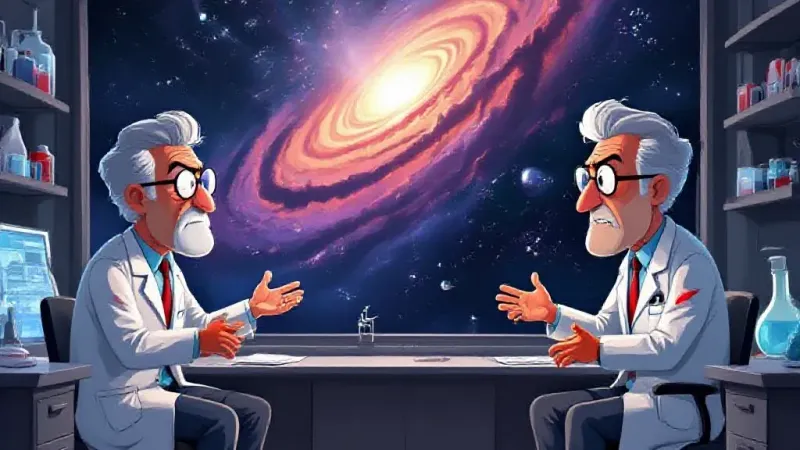
Pasadena, CA — A groundbreaking new study published today confirms what many cosmologists have privately suspected for light-years: the early universe was, for all intents and purposes, a massive cosmic teenager. According to researchers at the California Institute of Astrophysics, distant galaxies from billions of years ago exhibited behavior remarkably consistent with an entity that hadn't quite "found itself" yet, characterized by erratic star formation, questionable dark matter choices, and a general lack of coherent, adult-like structure.
"We observed these nascent galaxies just doing whatever," explained lead astronomer Dr. Elara Vance, visibly exhausted after what she described as "years of trying to get the universe to clean up its room." "They'd form stars too fast, too slow, sometimes in clumps, sometimes strung out in an 'edgy' spiral that clearly wasn't going to last. They were experimenting. You know, trying on different galactic identities before settling on something more stable, more... adult." Dr. Vance noted the gravitational forces involved were "very expressive, very moody," leading to what the paper describes as "unfiltered primordial chaos, much like a dorm room after a particularly ill-advised party."
The study, which meticulously analyzed light from the universe's infancy stretching back nearly 13 billion years, suggests that many of the anomalies previously labeled "unexplainable" or "contrary to established models" were simply the universe's equivalent of dyed hair, questionable fashion choices, and an inability to make its bed. "It wasn't a flaw in our physics," clarified co-author Dr. Kael Thorne, whose research focus now shifts to understanding why the early universe listened to so much terrible cosmic 'nu-metal.' "It was just the cosmos deciding its current gravitational constant was 'basic.' It needed to assert its independence before the Big Crunch told it what to do."
This revelation recontextualizes several astronomical mysteries previously attributed to exotic physics. The excessive quasar activity? A phase of "overcompensation" and a desperate cry for attention. The unexpected abundance of certain heavy elements in odd places? The universe was just "stress-eating" after an argument with the void. And the sudden formation of supermassive black holes without a clear progenitor? "That's just what happens when you let a billion light-years of hydrogen gas stay up all night playing 'cosmic Fortnite' on its own terms and make incredibly poor life choices," Dr. Vance added, adjusting her glasses and taking a long sip from a coffee mug that read "It's Not a Phase, Mom."
Astrophysicists now propose a new "Universal Adolescence Period" to better categorize these unruly cosmic behaviors, promising to adjust all future models to account for the universe's "mood swings." They anticipate further studies will reveal whether early galaxies ever regretted that one nebula tattoo or their brief, ill-fated dalliance with dark energy "influencer" culture.
The research concludes, with palpable relief, that the universe eventually grew out of it, thankfully, before any of its truly questionable early selfies could be preserved for eternity by highly advanced, judgemental alien civilizations.