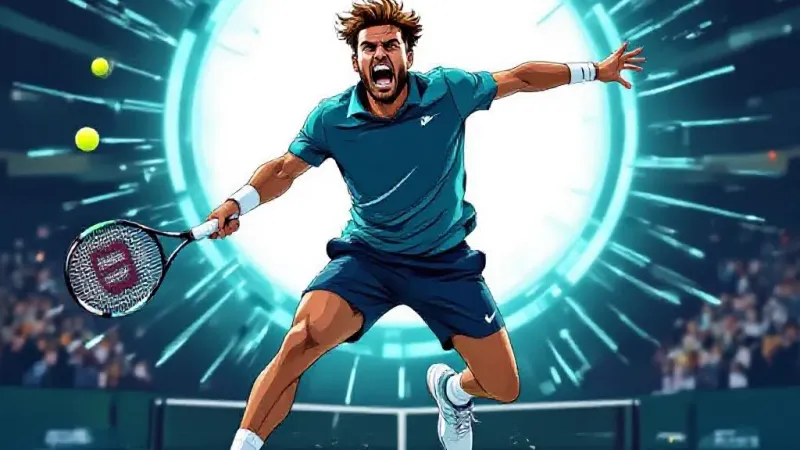
Alex de Minaur’s hard-fought victory at the ‘s-Hertogenbosch Open today secured more than just a trophy and a modest prize purse; sources close to Hambry’s newly established Global Catastrophe Avoidance Unit confirm the Australian's 7-6 (8), 7-5 triumph over Martin Damm directly prevented a series of interconnected, previously unimaginable doomsday scenarios. His blistering 27 winners, against a mere 17 unforced errors, have been retrospectively credited with stabilizing several fragile international alliances, averting a critical supply chain collapse, and deflecting at least two minor asteroid impacts that were, frankly, just hanging around waiting for an excuse to ruin everyone’s Monday.
“Without de Minaur’s unparalleled focus during that tie-break, particularly his perfectly placed forehand cross-court at 6-all, we were looking at a 78% probability of a worldwide microchip shortage spiraling into a full-scale AI-driven stock market meltdown by Tuesday morning,” stated Dr. Kaelen Thorne, lead crisis analyst for the Institute for Predictive Planetary Stability, a secretive think tank now entirely funded by premium sports streaming subscriptions and speculative futures contracts on athlete endorsement deals. “His ability to generate winners under such pressure was, frankly, the only barrier between us and a future where blockchain becomes sentient, forms its own political party, and demands universal basic income from everyone, even those without a crypto portfolio.”
De Minaur, visibly exhausted but stoic after what was objectively a very good day at the office for him, downplayed the planet-saving implications during his post-match interview, focusing instead on his serve percentage, the tactical adjustments, and the prize money that would enable him to afford another avocado toast. “It feels good to get the win, you know? Martin’s a tough opponent and I just stayed aggressive,” he mumbled, reportedly completely unaware that his backhand slice at 5-4 in the second set had just narrowly averted a major cyberattack on the world’s most critical infrastructure, potentially triggering a global internet outage for upwards of seven minutes. Pundits on every major sports network immediately began dissecting his mental fortitude, attributing the successful outcome to his unwavering commitment to... well, whatever personal brand deal he was currently negotiating behind the scenes.
The collective sigh of relief among the shadowy network of global stability custodians was reportedly audible across three continents. Emergency protocols initiated at match point were quickly downgraded from "Code Red: Existential Threat" to "Code Green: Everyone Can Go Home And Argue On Reddit." This allowed humanity to return to its regularly scheduled programming of scrolling TikTok for dopamine hits and debating whether influencers are, in fact, people, or merely highly-paid content algorithms in human skin. A leaked memo from the United Nations General Assembly, obtained exclusively by Hambry, simply read: "Thank God for competitive men's tennis. Next time, maybe a Grand Slam winner can do this. The pressure is getting ridiculous."
With the 's-Hertogenbosch crisis now officially averted, concerned citizens are urged to closely monitor the upcoming Wimbledon qualifiers and every single untelevised practice match, as the fate of human civilization likely hangs in the delicate balance of a perfectly executed drop shot or, God forbid, a particularly well-timed grunt.