
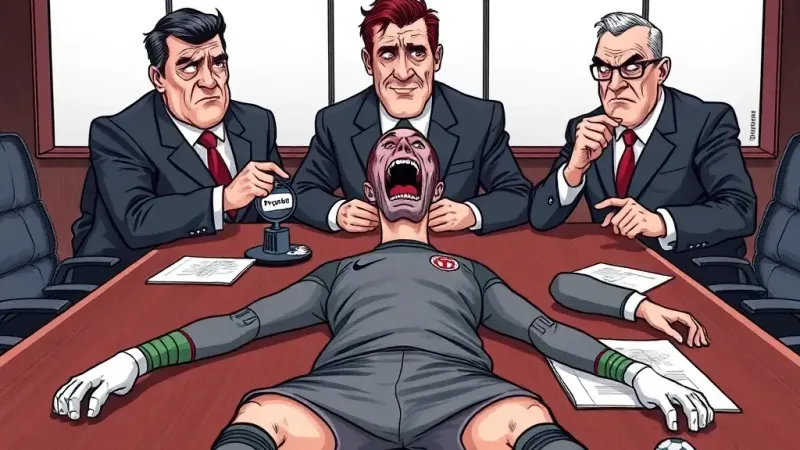
LONDON — A prominent international 2 club, which declined to be named but sources confirm operates a multi-billion-dollar global entertainment enterprise, issued a formal statement today. The statement clarified that all player bodies, along with their associated physiological data and public-facing narratives, are considered proprietary assets of the club, subject to strict internal information management protocols.
This unprecedented clarification comes in the wake of an incident involving one of the club's star goalkeepers, identified only as 'Player A,' who reportedly offered an unsolicited personal assessment of his own injury recovery timeline to a media outlet. Club officials quickly moved to reassert their exclusive right to dictate all public communications regarding player health and readiness, emphasizing that such information is strategic and not for individual dissemination.
“Our athletes are highly valued, high-performance units, and their physical integrity, recovery trajectory, and, indeed, their very corporeal existence, are central to our brand’s value proposition,” stated Dr. Evelyn Thorne, the club’s Head of Athletic-Narrative Integrity. “Allowing individual players to comment on their own proprietary biomechanical data without prior clearance introduces unnecessary volatility into our carefully managed public messaging framework. It’s simply unprofessional.”
Industry analysts were quick to praise the club’s proactive stance. “This is just late-stage capitalism meeting peak athletic commodification,” noted sports economist Dr. Kendrick Lowe from the London School of Predictive Sports Analytics. “Players are essentially walking, talking, highly skilled IP. Their ability to move, perform, and even *feel* belongs to the organization that invested hundreds of millions into developing and marketing them. Their internal sensations are, at best, anecdotal data points requiring centralized verification.” Dr. Lowe further suggested that future player contracts might include explicit clauses requiring internal thought-tracking or neural-interface monitoring to ensure compliance with official health statements.
The club confirmed it is exploring advanced bio-telemetry solutions to prevent similar unauthorized self-reporting incidents. Early trials include non-invasive neuro-linguistic programming to align player self-perception with official club medical reports. Player A, meanwhile, is understood to be undergoing a mandatory 'Re-Education Through Integrated Data Harmonization' seminar, focusing on the importance of organizational data sovereignty.
The club concluded its statement by reminding all personnel that independent thought, particularly regarding one's own physical state, remains a privilege, not a right, and is always subject to corporate oversight.