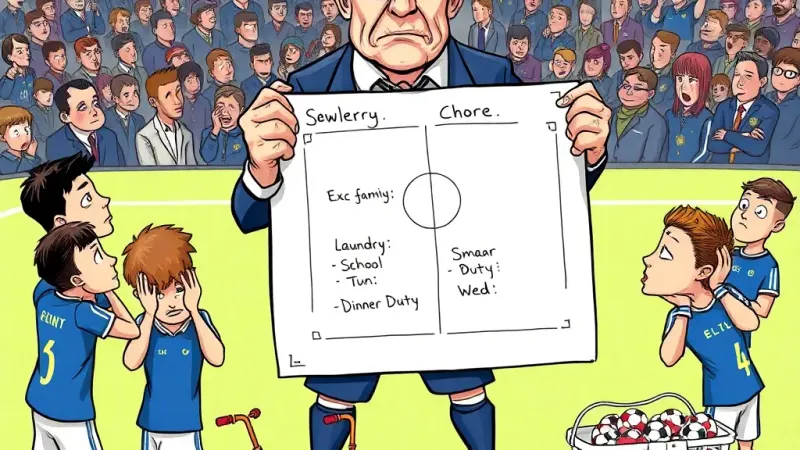
LONDON — Chelsea Football Club's interim manager, Frank McFarlane, has unveiled a radical new tactical philosophy designed to steady the ship at Stamford Bridge, which he succinctly termed the "work and home" approach. The strategy, a stark departure from traditional footballing doctrines focused on formations, pressing, or even the concept of "winning," emphasizes the fundamental principles of showing up to the workplace and subsequently returning to one’s personal residence for non-work-related activities.
McFarlane, who assumed the interim role amidst intense media scrutiny and fan unrest, articulated his proprietary two-point plan during a recent press conference. "My focus is incredibly straightforward," McFarlane stated, adjusting his perfectly pressed club tracksuit and avoiding eye contact with the wall of flashing cameras. "I come in, I do my work, and then I go home to my family. That’s it. All the chatter, all the online analytics, all the impassioned fan discourse – it simply doesn’t penetrate this highly optimized, bifurcated structure." He further clarified that "work" primarily involves observing players kick spherical objects, while "home" involves essential activities like "having dinner with my spouse" and "sleeping in my own bed."
Sports analysts were quick to praise the interim boss's innovative detachment as a potential game-changer for the notoriously high-pressure world of elite football. Dr. Evelyn Thorne, a behavioral economist specializing in high-performance apathy, lauded the strategy as a "paradigm shift in stakeholder engagement." "By completely ignoring the external pressures of a multi-billion-dollar global sports franchise and the emotional investment of its millions of paying customers, McFarlane is effectively bulletproofing himself against performance anxiety," Thorne explained to Hambry. "His refusal to acknowledge criticism isn't a flaw; it's a feature. It’s the managerial equivalent of an ostrich burying its head in the sand, but with significantly more brand synergy."
The revolutionary simplicity of McFarlane's approach has sent ripples across the Premier League. Several struggling clubs are reportedly investigating similar "life-first" methodologies, with Everton's new training regimen rumored to include mandatory "power naps" and "mindfulness walks away from the stadium." Sources close to Chelsea confirmed that key players such as captain Reece James and star centre-back Levi Colwill are indeed "back at work" and "not at home," which McFarlane cited as crucial progress. He reportedly told staff, "Their physical presence at the designated work location is a win, regardless of the score." Club officials, speaking anonymously, admitted the strategy was unexpected but offered undeniable benefits. "Frank doesn’t ask about transfer targets or long-term vision," one senior executive confessed. "He just wants to know if the changing rooms are tidy and if the tea kettle is working. It’s… refreshingly low-overhead for our HR department."
Fans, meanwhile, expressed a mixture of confusion and begrudging admiration for a strategy that felt less like a footballing vision and more like a detailed plan for enduring a particularly long Tuesday at the office. One season ticket holder, Gary 'The Gaff' Gaffney, summarized the mood: "I've been a Chelsea fan for 40 years, and I've never heard a manager say they're focused on 'trophies' or 'not getting fired next week.' This is... profoundly different."