
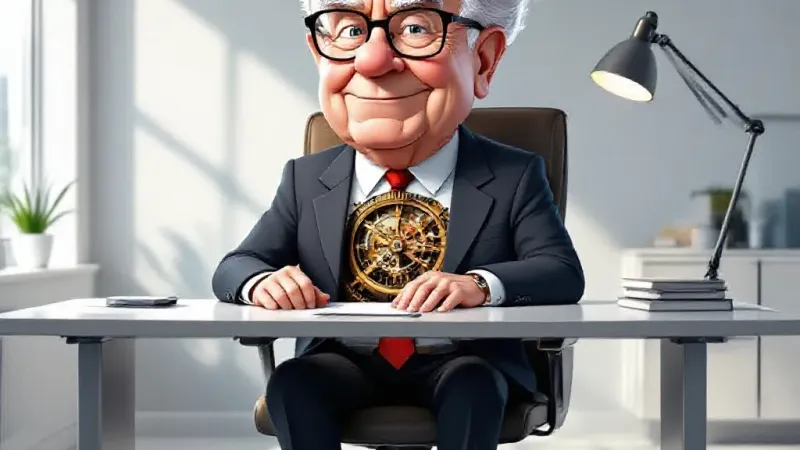
OMAHA, NE — Legendary investor Warren Buffett officially stepped down as chairman of Berkshire Hathaway today, citing what sources close to the company described as "unexpected and persistent biological limitations" that emerged after 93 years of continuous operation. His son, Howard Buffett, will assume the role, concluding a succession plan that company insiders say was "executed with surgical precision and the patience of geological time."
Buffett, known for his folksy wisdom and insatiable appetite for Dairy Queen, reportedly informed the board that "Father Time, a particularly aggressive venture capitalist, always wins." This revelation apparently came as a shock to the nonagenarian, who had, until recently, maintained an internal valuation of himself as "immortal, or at least indefinitely renewable." A leaked internal memo obtained by Hambry shows an early draft of the succession plan simply stating: "Step 1: Wait. Step 2: See."
"We are incredibly proud of Warren's decades of unwavering commitment, culminating in his recent, albeit reluctant, acceptance of basic human biology," stated Becky Quick, a Berkshire Hathaway board member and CNBC anchor, in a pre-recorded statement that appeared to have been prepared sometime around 1987. "His decision to finally acknowledge that even the most successful value investor cannot indefinitely defer cellular degradation truly showcases his pragmatic approach to capital allocation – even if that capital is his own bodily energy."
The long-heralded succession plan, often whispered about in hushed tones at annual shareholder meetings, involved a multi-decade observational period to ensure the younger Buffett possessed the requisite DNA. "It wasn't enough for Howard to just *be* Warren's son," explained one long-time Berkshire analyst. "He had to prove he could also survive for an extraordinarily long time without needing to actually *do* anything with the chairman title. It's a key part of the Berkshire ethos: stability through extreme inaction."
Sources indicate Buffett's final act as chairman involved meticulously calculating the opportunity cost of his continued existence versus the compound returns of his own slow decay. "He concluded that, while holding on offered negligible upside, the long-term systemic risk of a chairman who occasionally forgets where he parked his golf cart was beginning to outweigh the sentimental value," one board member reportedly quipped, careful to avoid eye contact with Buffett's framed portrait. "It's pure alpha to admit you're a human and not, say, a bond that never matures."
The transition, which analysts are calling "the slowest successful handoff in corporate history," paves the way for a new era at Berkshire. Howard Buffett, 69, is expected to bring a fresh perspective to the role, having spent the last six decades preparing for the day his father finally acknowledged the human condition. Observers speculate the company's next major strategic move will involve reviewing actuarial tables and perhaps investing in adult diapers, just in case.
The market, while initially surprised by the concept of a nonagenarian human being aging, quickly adjusted, noting that even the most enduring investments eventually reach their end-of-life cycle.