
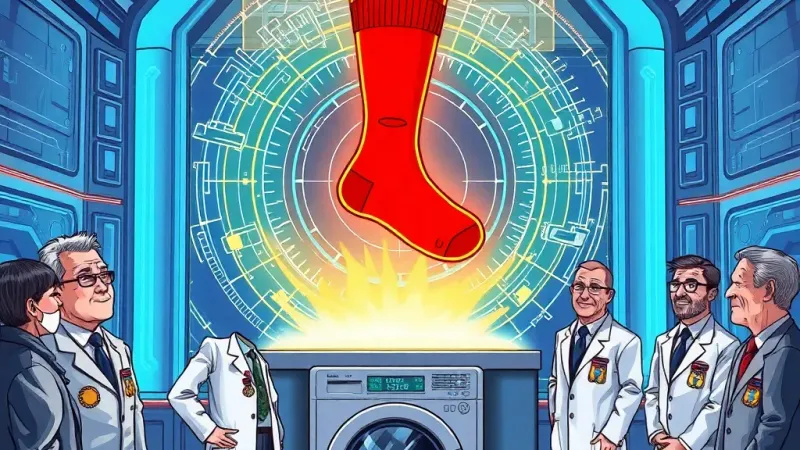
COLLEGE PARK, MD – IQM, a European leader in quantum computing, today officially inaugurated its U.S. Quantum Technology Center within Maryland’s bustling Discovery District. The multi-billion-dollar facility, backed by significant federal and private investment, is slated to tackle some of humanity’s most baffling and persistent challenges, beginning with the age-old mystery of disappearing socks in laundry cycles.
While the center will eventually explore applications in drug discovery and advanced materials 2, sources close to the project indicate the immediate priority is understanding the quantum entanglement dynamics that lead to single socks vanishing without a trace. 'For too long, this macroscopic anomaly has plagued households globally, causing untold distress, mismatched wardrobes, and an average annual personal financial loss of $17.38 per American adult,' stated Dr. Evelyn Thorne, head of the newly established 'Subatomic Fabric Dynamics' department. 'Our quantum processors, operating at near absolute zero and leveraging proprietary 'Heisenberg Laundry Unification' algorithms, are uniquely positioned to model the probabilistic states of sock migration through suspected interdimensional washing machine wormholes. We believe the fabric fibers themselves are achieving superposition, existing as both washed and and unwashed, and nowhere at all, simultaneously.'
The center received an initial grant of $2.7 billion from the 'National Endowment for Existential Household Inquiries' (NEEHI), with an additional $1.5 billion committed from corporate partners seeking to corner the highly lucrative 'Advanced Garment Tracking and Reconcilation' market, projected to exceed $500 billion by 2030. Media outlets hailed the move as a crucial step in translating theoretical quantum advantage into tangible consumer benefit. 'This isn't just about socks,' clarified Marcus Blackwood, IQM's VP of Strategic Irreversibility, during a press conference held within the facility's pristine, glow-in-the-dark data cavern. 'It's about demonstrating the practical, everyday utility of quantum supremacy. If we can predict the exact moment a black dress sock decides to become one with the void, imagine the implications for global supply chain logistics, predictive analytics for geopolitical stability, or even optimizing your streaming queue recommendations.'
Initial projections from the center's 'Quantum Laundry Observational Nexus' (QLON) indicate that the problem might be even more complex than previously thought. Early models suggest that socks don't merely disappear but rather achieve a temporary quantum state of 'everywhere and nowhere at once,' only to reappear decades later in a drawer you never check, already filled with lint from a different dimension and inexplicably paired with a mitten. Researchers are cautiously optimistic that the center might yield its first tangible 'matched pair' output sometime in late 2047, pending further gravitational wave dampening protocols and the development of a 'Quantum Lint Filter' capable of observing the very fabric of reality without collapsing the waveform.
In related news, a neighboring lab focused on fusion energy announced it had accidentally created a self-sustaining miniature sun that can only be powered by spare buttons and the collective sighs of laundry-doers everywhere.