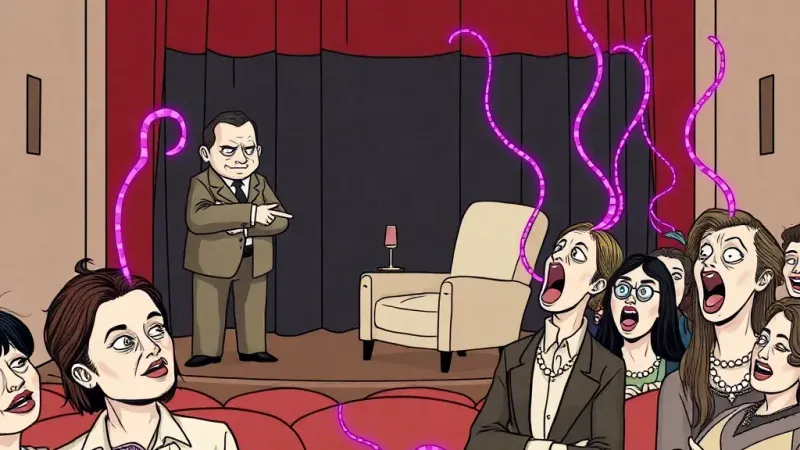
ENGLEWOOD, NJ – Audiences at the Bergen Performing Arts Center (bergenPAC) reportedly demonstrated an extraordinary collective willingness this weekend to set aside fundamental understandings of physics and consciousness to enjoy a ventriloquism performance. Patrons, many of whom possess college degrees and operate complex machinery in their daily lives, enthusiastically embraced the theatrical convention that a human being’s hand-operated dummy was, in fact, an autonomous entity capable of independent thought and speech.
“It’s truly a remarkable phenomenon,” stated Dr. Elara Vance, chair of Cognitive Dissonance Studies at the University of Northern Jersey. “For two hours, individuals capable of critical thinking and discerning complex information about, say, stock portfolios or orbital mechanics, completely commit to the idea that a piece of wood with googly eyes is articulating witty retorts. It’s a testament to the human desire for simple, unquestioning entertainment, especially after a week of being forced to confront actual reality.”
Attendees described the experience as “uplifting” and “a much-needed escape.” Sources close to the venue confirmed that at no point during the performance did any audience member physically investigate the mouth of the inanimate objects to confirm their alleged vocal capabilities. This adherence to unwritten social contract underscores a deep-seated, if rarely acknowledged, cultural commitment to enjoying things at face value.
“We market it as ‘Pure Imagination,’ and what we deliver is precisely that,” explained Brenda Maxwell, bergenPAC's Director of Audience Engagement. “People come here to believe. They want to believe that a small, fabric-covered figure has a distinct personality and a compelling backstory. They pay good money for that belief. Our job is to facilitate that, and if that means everyone collectively agrees to ignore the visible human hand up a puppet's posterior, then that’s the magic of live theater.”
The performance also featured several song-and-dance numbers, further solidifying the shared illusion. Behavioral analysts are now examining whether this highly localized suspension of disbelief can be harnessed for other, more pressing societal issues, or if it is exclusively reserved for talking inanimate objects.
Ultimately, the evening proved that for a significant portion of the population, the pure imagination required to accept a talking puppet is far less taxing than engaging with the actual, difficult truths of the outside world.