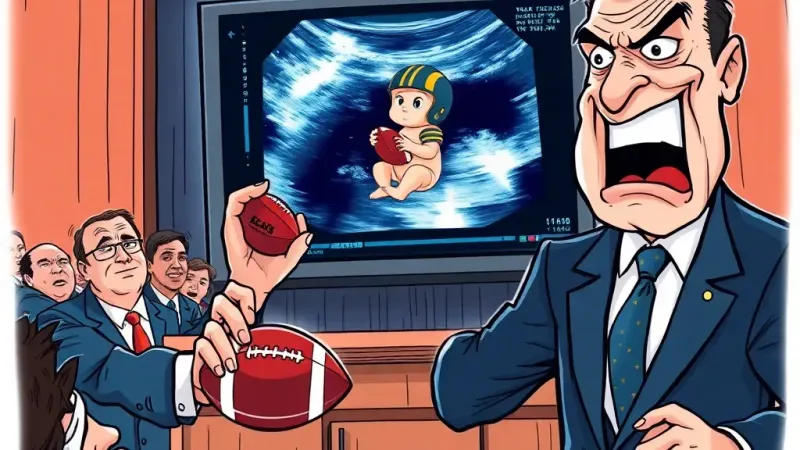
CHICAGO – The Chicago Bears have initiated a groundbreaking legal appeal, challenging the National 2 League's decision to rescind a projected 2027 third-round compensatory draft pick. The team's argument reportedly centers on the assertion that a future draft selection represents a tangible, albeit nascent, asset with inherent value, akin to an 'unborn player' whose potential contributions should be protected by fundamental league precedent.
The dispute originates from a now-reversed ruling that would have awarded the Bears the pick if Assistant General Manager Ian Cunningham left for another team's GM vacancy. While the 2 initially affirmed the pick under its executive diversity initiative, it later rescinded the award, citing a misapplication of internal rules. The Bears' counter-filing is rumored to delve into the metaphysics of player valuation, questioning whether a draft pick only gains 'personhood' upon selection, or if its theoretical existence prior to that point warrants legal consideration.
"This isn't merely about a number on a spreadsheet; it's about the sanctity of potential human capital within our meticulously structured ecosystem," stated Dr. Aris Thorne, a fictional adjunct professor of Quantum Jurisprudence at the University of Midwestern Philosophy, who is not affiliated with the Bears but offered his unsolicited opinion. "To deny the intrinsic worth of a future third-round selection is to deny the very spirit of meritocratic competition, undermining the entire philosophical bedrock of the modern 2 draft system, Section 4.b.ii(gamma) notwithstanding."
Sources close to the appeal process indicate the Bears’ legal team has submitted a 1,200-page brief, complete with expert testimony from economists who have calculated the projected GDP impact of a theoretically optimal third-round pick in 2027 at approximately $780 million over a player's first seven seasons. The brief also includes a detailed astrological chart predicting the optimal birth window for a high-performing defensive end.
The NFL's appellate committee, a body normally tasked with deciding whether a player's glove touched the ground before the ball, is now grappling with philosophical questions typically reserved for late-night college dorm discussions. A league spokesperson, speaking on condition of anonymity, admitted the situation has forced them to consider whether the NFL might need to establish an 'Ombudsman for Abstract Draft Asset Rights,' or possibly just simplify the entire damn rulebook.
Ultimately, the league must decide if a team can claim emotional distress on behalf of a player who currently exists only as a mathematical probability within a future draft class.