
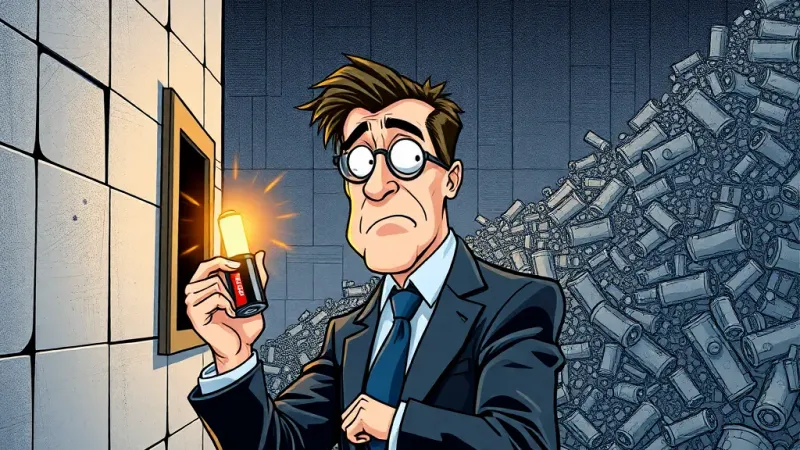
WASHINGTON D.C. — EverCharge Solutions, a once-promising battery recycling startup lauded for its commitment to a "circular 2" and "sustainable future," announced its filing for Chapter 11 bankruptcy this week. The company cited a "challenging market environment" compounded by the sudden withdrawal of a multi-million-dollar federal grant, and, perhaps most critically, what CEO Dr. Alistair Finch described as the "unexpected and frankly aggressive insistence from the market on generating actual, consistent profit."
"We genuinely believed that the sheer virtue of our mission — saving the planet, one discarded lithium-ion cell at a time — would naturally translate into a viable long-term business model," stated Dr. Finch in a surprisingly candid press release issued from what appeared to be a repurposed storage locker. "Our projections focused heavily on 'societal impact metrics' and 'ESG alignment scores.' It turns out investors and creditors also wanted things like 'positive cash flow' and 'a clear path to self-sufficiency,' which, to be perfectly honest, felt a bit transactional given the magnitude of the climate crisis."
The company's financial woes reportedly escalated after the Department of Energy rescinded a $150 million grant, citing "evolving national strategic priorities" which sources close to the department clarified as "a renewed focus on things that don't immediately lose money." EverCharge Solutions had previously based much of its operational strategy on this grant, having invested heavily in highly specialized equipment designed to deconstruct end-of-life battery packs into their constituent elements, primarily for use in novelty keychains and, occasionally, new batteries.
Industry analyst Brenda Sterling, managing director at Greenwash Capital Insights, was less surprised by the development. "This isn't new," Sterling commented during a virtual seminar titled 'The Illusion of Green Profit.' "For years, many 'sustainable' ventures have operated under the implicit assumption that being morally superior exempts them from basic economic principles. When the government's free money faucet turns off, or when consumers aren't willing to pay a 400% premium to recycle their old laptop battery, the 'circular 2' starts looking a lot like a broken circle."
EverCharge’s bankruptcy filing notes that while they successfully recycled approximately 75,000 metric tons of batteries last year, their revenues consistently failed to achieve net positive values, primarily because the market price for recycled materials often dipped below the cost of collection, transport, and highly technical extraction. "We were essentially performing a public service at a significant financial loss," Dr. Finch explained, "which, in hindsight, is perhaps why governments usually fund public services themselves." The company is now exploring options, including a possible pivot to "advanced artisanal paperweight manufacturing."
The news serves as a stark reminder that even the most altruistic endeavors can be tripped up by the antiquated concept of "paying for things."
Hambry is a satire publication. All articles are works of fiction.