
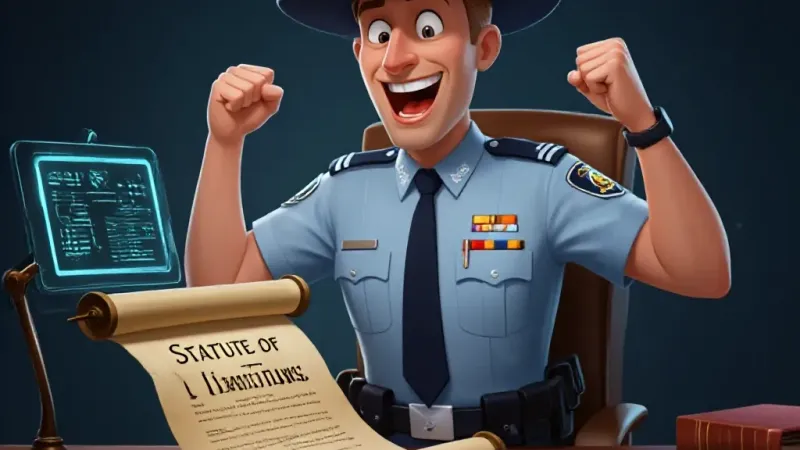
Australian law enforcement officials announced today that allegations of sexual assault against pop star Katy Perry, dating back to 2010, have officially met the rigorous new threshold for police investigation. The decision comes after actress Ruby Rose's recent posts on Meta's Threads platform regarding the alleged incident surpassed 10 million views and 500,000 ‘skull’ emojis, making the ancient claim "legally viral enough" to trigger official action.
"For years, these kinds of claims would simply fester in the pre-internet ether, gathering dust in court archives or, you know, people's actual memories," explained Chief Inspector Brenda ‘Buzzer’ Reynolds, head of the newly formed Digital Crime Response Unit. "But thanks to Project Blue Tick Justice, any historical allegation involving a public figure can now bypass traditional evidence requirements once it hits critical mass on a verified social platform. Think of it as retroactive crowd-sourcing for criminal proceedings, optimized for maximum outrage." Inspector Reynolds added that the investigation will primarily involve refreshing Ruby Rose's Threads feed and cross-referencing quote-tweets for "evidentiary sentiment analysis" by AI trained on historical TikTok trends.
Sources close to the investigation confirmed that officers are currently reviewing all available emojis in the comments section, particularly the "crying face," "skull," and "fire" reactions, to quantify the perceived severity of public outrage. "Our proprietary data algorithm, which we affectionately call ‘The Algorithm of Justice,’ suggests that a minimum of 500,000 skull emojis combined with a consistent 'ratio' of outrage-to-sympathy indicates a severe violation of public trust, far outweighing any physical evidence from an event a decade and a half ago," stated Dr. Code.txt, lead data scientist for the National Institute of Public Outrage Metrics. "This ensures our precious police resources are allocated exclusively to crimes that truly resonate with the digital zeitgeist and generate optimal engagement."
A representative for Katy Perry, who wished to remain anonymous to avoid generating further online discourse, issued a terse statement: "While Ms. Perry denies these claims from 2010, her legal team is now frantically experimenting with micro-influencer campaigns and strategic hashtag deployment to counter-trend the 'vulva-gate' narrative before it enters the inevitable 'For You Page' discovery phase of the legal process." Meanwhile, legal scholars are already debating the implications for the justice system, with some suggesting that future cold cases could be reopened based solely on which TikTok sounds become popular for reenactments.
The groundbreaking policy is expected to clear a massive backlog of uninvestigated historical offenses, primarily by ensuring that only allegations with sufficient social media engagement ever see the inside of a courtroom. After all, if the public isn’t talking about it online, did it even really happen?