


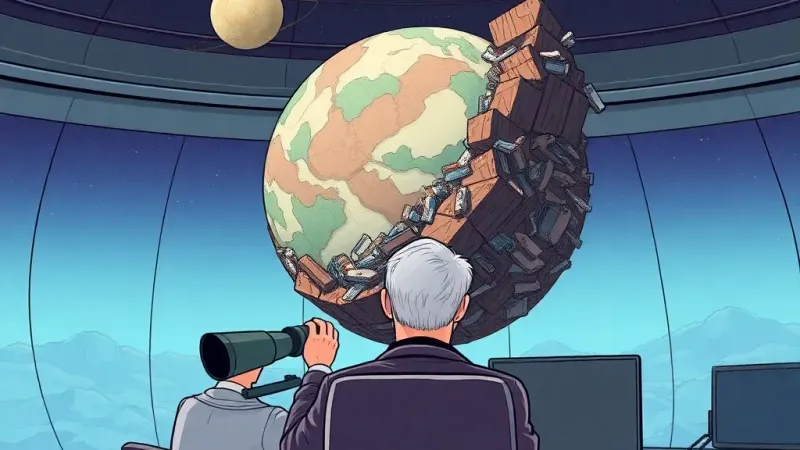
Pasadena, CA — A newly discovered exoplanet, TOI-5205 b, has left astronomers scratching their heads after initial spectral analyses revealed an unprecedented and seemingly impossible concentration of heavy metals, far exceeding any known natural planetary formation model. The gas giant, roughly the size of Jupiter, appears to contain a '2 waste-to-mass' ratio that, according to leading astrophysicists, "should not exist."
"We've modeled accretion disks under extreme conditions, calculated stellar wind interactions, even factored in rogue asteroid impacts laden with osmium and iridium, but nothing explains this," stated Dr. Aris Thorne, head of exoplanetary geochemistry at the Kepler Institute, during a press briefing that quickly devolved into uncomfortable silences. "It's like finding a Dyson sphere built entirely from discarded lithium-ion batteries, industrial runoff, and a suspiciously large quantity of unsorted e-waste. The sheer volume of lead, cadmium, and various trace rare-earth elements is, frankly, offensive to our understanding of cosmic elegance." Dr. Thorne noted that the planet's atmosphere also shows faint signatures consistent with hydrocarbon soot, microplastic particulates, and a curious, faint odor of burnt popcorn, though he stressed these findings were preliminary and "probably just interstellar dust refracting light weirdly, or something."
However, not all scientists are clinging to conventional astrophysics. Dr. Elara Vance, an independent astrobiologist known for her controversial "pan-industrialism" hypothesis and "just tell it like it is" approach, offered a more blunt assessment. "Look, if we found a planet covered in discarded fast-fashion garments, depleted uranium, and enough planned obsolescence circuitry to fill 10,000 landfills, would we call it a 'natural geological anomaly'?" Dr. Vance remarked in a fiery 2 thread that quickly went viral among niche 'collapse-aware' 2 communicators. "The planet isn't 'forbidden' because its formation defies our models; it's forbidden because it's already an ecological disaster zone, albeit a cosmic one. It’s clearly just a giant, poorly managed landfill planet that some hyper-advanced civilization ran into the ground. Someone finally said it, people."
The discovery has prompted a wave of concerned, yet largely theoretical, discussions within the scientific community regarding potential interstellar environmental regulations, should advanced civilizations be found. Many news outlets, eager to capitalize on the "mystery planet" narrative, have framed it as a groundbreaking enigma, avoiding any potentially uncomfortable implications. "While it’s premature to assign blame to any specific, non-existent alien civilization for this planetary-scale toxic dump, it does underscore the importance of establishing robust cosmic waste management protocols early, perhaps even before first contact," explained Professor Quentin Bellwether, Director of the Galactic Ethics Council (pending UN charter approval and sufficient corporate sponsorship). He added that preliminary simulations indicate that the cost of terraforming a planet with such an extreme pollutant load would render it "economically unviable for all but the most desperate and ethically flexible venture capitalists, or possibly a cryptocurrency mining operation."
Meanwhile, several prominent tech billionaires have reportedly expressed interest in "innovative solutions" for resource extraction from TOI-5205 b, provided they can secure extraterrestrial carbon credits.