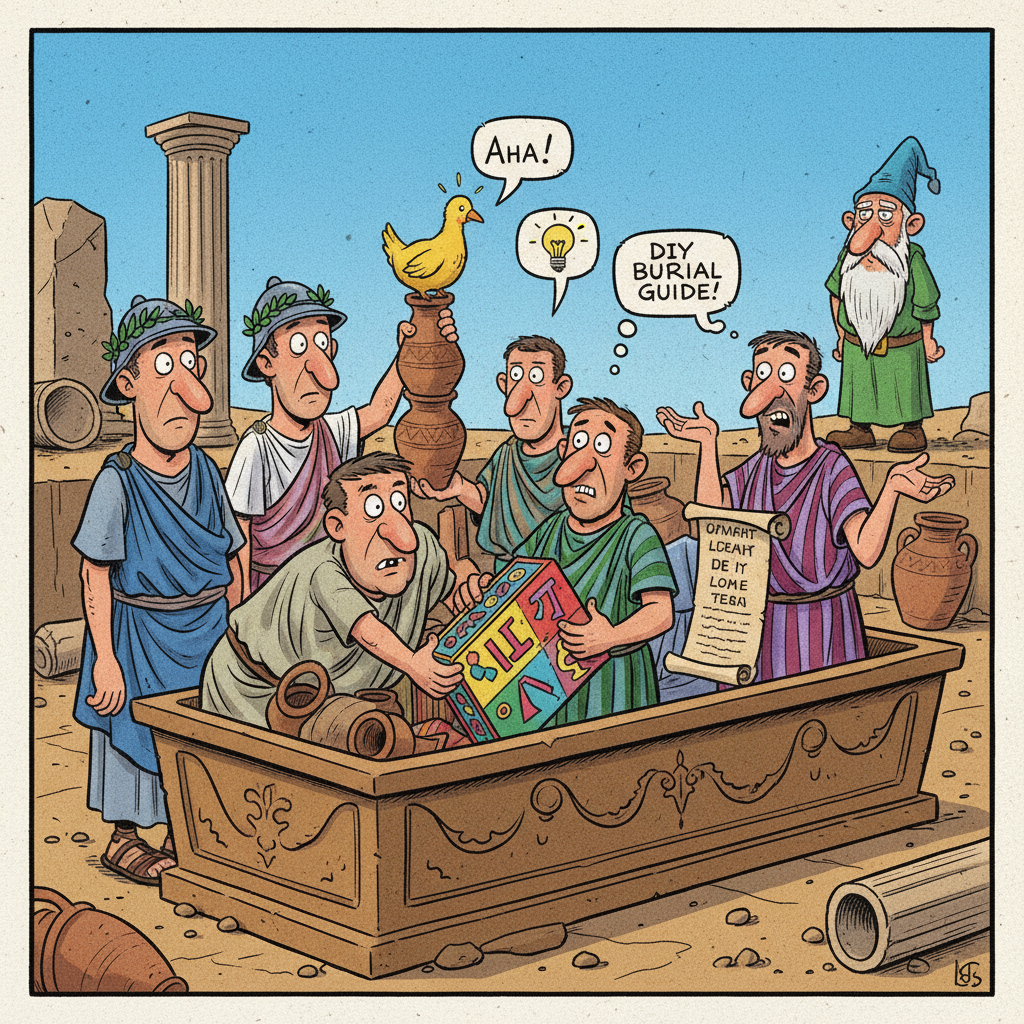
ROME — A groundbreaking discovery in Rome’s Ostiense necropolis has confirmed what many historians have long suspected: ancient civilizations, much like modern ones, often improvised their spiritual practices with varying degrees of conviction. Archaeologists unearthed three skeletons with iron nails strategically placed on their chests, a practice theorized to “protect” both the living and the dead from restless spirits.
“For centuries, we’ve attributed profound, mystical significance to every ancient artifact,” stated Dr. Lena Petrova, lead archaeologist on the dig. “But honestly, the more we dig, the more it looks like they were just trying things. ‘Nails on the chest? Sure, why not? Can’t hurt, might help.’ It’s the ancient equivalent of unplugging your router and plugging it back in when the internet goes out.”
The team’s analysis suggests the nail placement wasn't part of a widely documented, codified ritual, but rather a localized, experimental approach to necromancy. “We found no scrolls, no frescoes, no grand pronouncements about the 'Sacred Nail Placement of the Undead Repulsion,'” Dr. Petrova elaborated. “Just some guy, probably named Gaius, saying, ‘My aunt’s ghost is being a real pain, maybe if we put these pointy bits on her, she’ll stay put.’ And then it just sort of caught on for a bit.”
Experts believe this revelation could redefine our understanding of ancient belief systems, shifting from rigid dogma to a more fluid, trial-and-error methodology. “It’s comforting, in a way,” added Dr. Marcus Thorne, a cultural anthropologist. “Knowing that even the mighty Romans occasionally resorted to spiritual duct tape makes them feel a lot more relatable.”
The findings are expected to inspire a new generation of historians to question whether the pyramids were really about pharaohs, or just a very elaborate way to store grain that got out of hand.