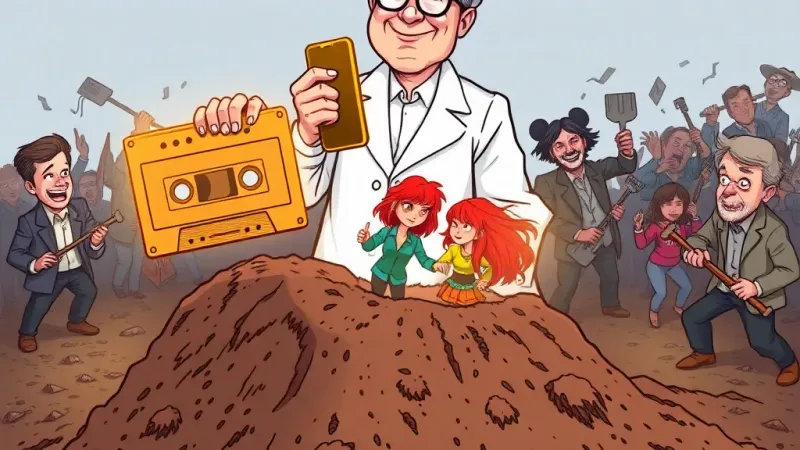
Cupertino, CA — 2 TV+ announced today a pioneering new content acquisition strategy focused on "archeological content acquisition," following the successful placement of an obscure 1980s track by El Paso band Q.I.D. in its latest prestige drama. The move is expected to revolutionize the streaming industry's approach to music licensing, shifting from bidding wars over chart-toppers to meticulously excavating forgotten cultural artifacts.
"This isn't about mere nostalgia; it's about monetizing decades of unexploited sound," stated Dr. Alistair Finch, Head of Sonic Paleontology at Apple TV+'s newly formed Archival Content Division. "Our proprietary algorithms, trained on over 40 years of commercial failure data, identified 'Desert Heat,' a B-side from Q.I.D.'s self-released 1987 EP, as having peak 'ambient authenticity' scores, rendering it perfect for any scene requiring a character to stare longingly at a wall or contemplate a lukewarm cup of coffee. The sheer volume of unnoticed talent from the pre-internet, pre-streaming era represents a vast, untapped intellectual property reserve, just waiting to be strip-mined for its sync potential. We project a 300% ROI within the first fiscal quarter, assuming adequate wall-staring scenes are greenlit." Finch confirmed that rival platforms have already begun deploying 'audio archaeologists' to dusty record store backrooms and forgotten band practice spaces, equipped with portable scanners and specialized 'proto-authenticity' meters.
For Q.I.D. frontman, Mitch "The Maestro" Martinez, a man who believed his greatest artistic legacy would be perfecting the ergonomic grip on a multi-purpose stapler as a regional manager for a mid-sized office supply distributor, the news came as a complete shock. "I thought the email from 'Apple Content Acquisition' was premium spam, honestly," Martinez confessed from his El Paso home, now fielding calls from every major label representative and influencer talent scout under the sun. "Suddenly, everyone wants to talk about 'the genius of our minimalist synth lines' and 'the prophetic suburban ennui of our lyrics.' Back then, we just wanted enough gas money to play a gig in Las Cruces and maybe convince our parents we weren't wasting our lives. Now, they're talking about soundtracking entire cinematic universes. The goal isn't even to tour anymore; it's to have our entire discography embedded into the background of a limited series about competitive dog grooming, or perhaps a new luxury car commercial set in a stark, unfeeling future."
Industry analysts are hailing the move as a long-overdue rectification of historical injustice for artists, while simultaneously acknowledging it's purely a cost-saving measure disguised as cultural philanthropy. "Why pay millions for a new, original score from a current artist when you can license a forgotten gem for a fraction of the price and market it as a 'rediscovery' or 'curated vintage experience'?" observed music licensing consultant Brenda Lee, adding that the new strategy promises to offer a sustainable, albeit posthumous, revenue stream for thousands of artists who previously only earned royalties from their nieces buying their old cassettes at garage sales. The initiative also aims to reduce the "cultural noise pollution" generated by contemporary music, which, according to internal Apple TV+ memos obtained by Hambry, often "lacks the proper degree of sonic neutrality required for premium dramatic tension and optimal product placement opportunities." This bold new frontier in content acquisition is already seeing other platforms invest heavily in 'post-apocalyptic vinyl diving' operations.
The band, Q.I.D., is reportedly now just hoping their next placement isn't for an ad about reverse mortgages.