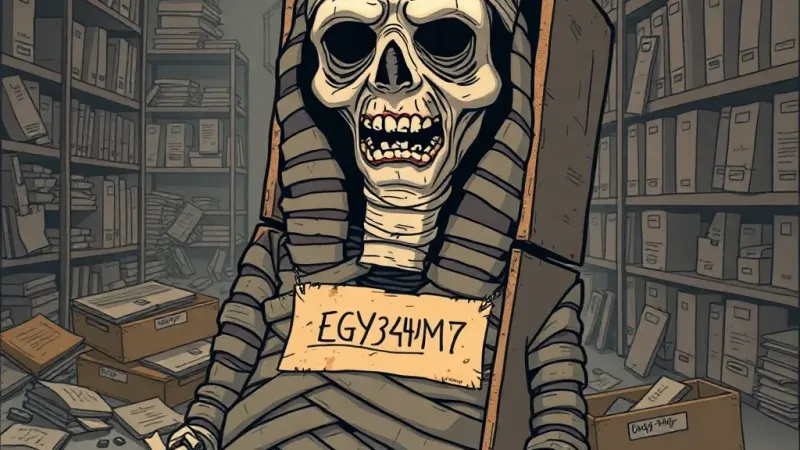
CAIRO, EGYPT – After two millennia, the greatest remaining mystery surrounding the “unknown child” mummy, a relic recently identified as dating to the 1st century AD, is not its lineage or cause of death, but rather its original accession number and associated contextual notes, which were misplaced during World War II. Researchers at the Grand Egyptian Museum confirmed this week that the critical information, vital for understanding the mummy's provenance, was inadvertently destroyed or misfiled sometime between 1943 and 1945.
The child, approximately five years old at the time of death, holds a small, tightly wrapped object, which scientists initially hailed as a potentially groundbreaking discovery. However, Dr. Elara Vance, head of the museum’s Anomaly Identification & Archival Retrieval Taskforce, clarified that the artifact itself is now secondary to the institutional failure. "Frankly, the biggest archaeological puzzle isn't what’s *inside* the linen wrappings, it's what was *missing* from the catalog card," Dr. Vance stated during a press conference. "We spent millions on a new spectral imaging array only to find the core data point was probably just crumpled up and used as an ash tray liner by an understandably stressed junior archivist fleeing the Blitz. Or, worse, meticulously filed under 'Miscellaneous Unimportant Deaccessioned Scraps'."
The newly launched "Operation Phoenix Ledger" aims to cross-reference fragmented inventory lists, pre-war shipping manifests, and even handwritten notations in the margins of surviving curatorial meeting minutes, hoping to reconstruct the full record. The project, funded by a consortium of international grants totaling €17 million, involves experts in cryptanalysis, historical bureaucracy, and the obscure field of "institutional memory archaeology." Early theories suggest the missing catalog number, possibly "GEM-XII-07-C34," could hold the key to uncovering which British field team excavated the mummy and, more importantly, whether its original discovery came with an attached invoice that needs processing, currently stalling crucial grant applications. The taskforce estimates a 60% chance of recovery within five to seven years, provided no further "temporary reorganizations" of the archive occur.
Initial high-resolution spectral scans of the mystery object within the mummy have yielded inconclusive results, suggesting it could be a small funerary amulet, a miniature clay toy, or even a remarkably well-preserved petrified pigeon dropping. Yet, the consensus among the scientific community is that even if the object proved to be a priceless artifact that rewrites the history of Pharaonic childhood, its true value would remain diminished without the foundational understanding that a properly maintained file card would provide. "Imagine discovering the Mona Lisa but the gallery label just says 'Portrait of a Lady, Unknown Artist, c. 1500, possibly from Italy,'" explained Professor Quentin Thorne of the Institute for Antiquarian Administrative Sciences. "It's still *the Mona Lisa*, yes, but it’s also a catastrophic breach of best practices, preventing accurate insurance valuation and, crucially, making it impossible to ascertain who signed off on its initial acquisition paperwork."
The effort highlights a growing trend in modern archaeology, where the "discovery" often involves re-discovering information lost due to historical administrative oversight rather than unearthing new physical artifacts. "We're not just excavating dirt anymore; we're excavating forgotten spreadsheets and poorly transcribed phone logs," added Dr. Vance. "It’s less Indiana Jones and more 'forensic accounting for ancient history,' complete with the 2 of realizing your entire field's intellectual foundation rests on the quality of a 1940s clerk’s penmanship. And frankly, the penmanship then was often appalling." The museum plans to digitize all remaining analog records, but not before conducting an internal audit to determine if the digitization plan itself has an assigned catalog number.
The museum is currently exploring the possibility of using AI to generate plausible historical catalog entries, pending ethical approval from the international community of deeply disappointed historians.