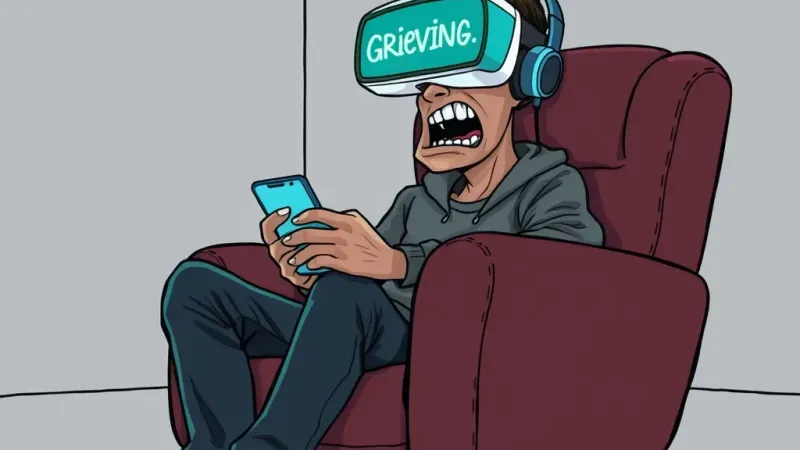
SEATTLE—In a bold move to ensure customers fully appreciate the emotional gravity of saving fourteen dollars on a USB-C cable, Amazon unveiled a newly optimized Prime cancellation protocol on Tuesday that requires users to legally adopt a retired warehouse manager before their subscription can be terminated.
The updated exit flow, quietly deployed in the chaotic wake of Cyber Monday, replaces the traditional two-click cancellation button with a multi-tiered journey designed to challenge the user's resolve, moral character, and overall fitness for modern consumer society. Departing members must now successfully navigate twelve distinct emotional checkpoints, including a mandatory video conference with a machine-learning algorithm disguised as an estranged parent who is deeply disappointed in your financial choices and wants to know why you never call anymore.
"We found that customers attempting to cancel their subscriptions were experiencing a dangerous lack of existential dread," said Amazon senior vice president of customer retention Marcus Vance, speaking from a climate-controlled bunker lined entirely with unboxed air fryers and discarded cardboard boxes. "By introducing friction, we are actually providing a valuable mindfulness service. When a user spends forty-five minutes staring at a high-definition photograph of a sad golden retriever while trying to turn off free two-day shipping on cat litter, they aren't just canceling a service. They are confronting the void. And honestly, they probably just need a new lint roller anyway."
According to early beta testers, the new cancellation wizard begins innocently enough with a button labeled 'Do You Hate Savings and Freedom?' Clicking it immediately triggers a pop-up window that freezes the user's browser and plays a looping audio track of a corporate executive laughing gently inside a sub-orbital spacecraft.
From there, users are required to complete a comprehensive demographic survey detailing every impulse purchase they made during the holiday weekend, followed by a written essay explaining why they hate logistics and despise the concept of getting a package on a Tuesday. Those who manage to press onward are greeted by a series of increasingly frantic digital roadblocks designed to wear down the human spirit. The system will alternately offer to extend the membership for the price of your firstborn child, suggest that your neighbors will secretly judge you for buying groceries at a physical store, or simply pretend that the internet has been invented backwards and your browser is no longer compatible with commerce.
Industry analysts have praised the architecture of the dark pattern, noting that it successfully weaponizes human politeness and sheer exhaustion against the defenseless consumer.
"It's a masterclass in modern corporate hostage negotiation," said retail analyst Brenda Higgins. "Amazon understands that modern humans will willingly surrender their constitutional rights, their biometric data, and half their retirement savings rather than click 'Are you sure?' three times. Adding a grieving spouse simulator to the mix is just efficient engineering at scale."
Company representatives confirmed that users who actually manage to reach the final screen will not be allowed to leave until they correctly guess the middle name of the delivery driver currently idling outside their apartment building with a single paper envelope containing three AA batteries. Those who fail are automatically enrolled in a lifetime subscription to an exclusive video tier featuring behind-the-scenes footage of algorithms calculating the precise moment your joy departs.
Despite the grueling hurdles, consumer advocates report a slight uptick in successful cancellations, mostly among individuals who simply threw their laptops out the window, canceled all electricity, and moved to an isolated cabin in the woods. Amazon executives remain entirely unfazed by the churn, pointing out that even if users manage to delete their accounts, the lingering psychological trauma ensures they will still subconsciously whisper the company name whenever they drop their keys.