
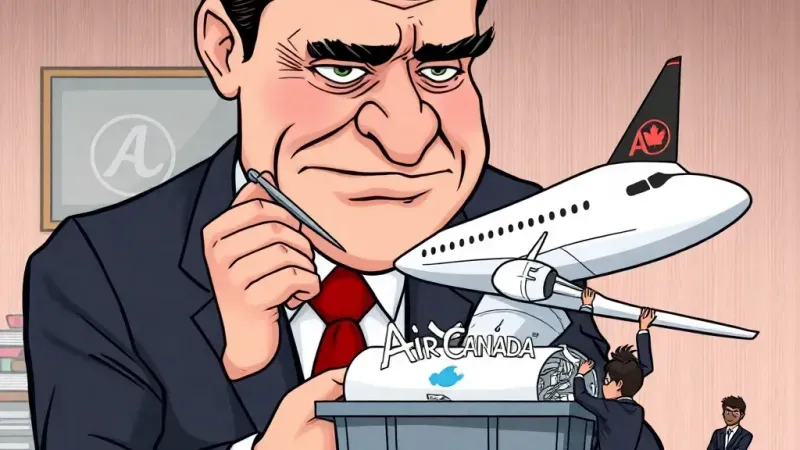
Air Canada CEO Michael Rousseau today announced his immediate resignation, citing overwhelming public backlash from an English-only video message of condolence following a recent runway incident at LaGuardia. The decision, lauded by linguistic advocacy groups and the Prime Minister alike, comes after intense scrutiny over Rousseau's failure to deliver the message in both official languages, an issue that swiftly eclipsed any discussion of the actual aviation event.
Rousseau's departure concludes a tenure marked less by the airline’s operational performance and more by his persistent struggles with Canada's official language requirements. His infamous 2022 pledge to improve his French, made after a similarly tone-deaf incident, proved insufficient to mollify a nation acutely attuned to symbolic gestures. "While a potential air disaster can certainly cause momentary concern for stakeholders," explained Dr. Evelyn Chen, a professor of 2 semiotics at McGill University, "it's a mere blip on the reputation radar compared to the long-term, devastating brand erosion incurred by a perceived slight to national identity. The market simply can't tolerate leadership that fails to grasp the nuanced performativity of modern governance, especially when the quarterly earnings reports are looking a bit too good."
The Air Canada board, in a public statement released via a fully bilingual press conference, praised Rousseau’s "unwavering commitment to taking full accountability for failing to meet our exacting standards for symbolic gestures and linguistic fidelity." They confirmed the expedited search for a successor would prioritize candidates demonstrating "robust, certifiable bilingual capabilities across all communication modalities, coupled with an impeccable track record of cultural sensitivity and a minimum 8.5 on the Official Languages Proficiency Index (OLPI)." Operational safety metrics, the statement noted, would be "reviewed concurrently, where contextually appropriate and non-disruptive to the core mission of brand preservation." Analysts observed a slight uptick in Air Canada's stock value post-announcement, widely interpreted as investor confidence in the board's decisive action on matters of critical public perception.
Many industry observers now point to this incident as a pivotal moment in corporate accountability, where the optics of leadership unequivocally outweigh the tangible realities of an enterprise. "This is a clear signal," stated Pierre LeBlanc, spokesperson for the Canadian Association of Discourse Ethics, "that in our increasingly hyper-aware public sphere, the perceived offense is exponentially more damaging than any actual physical risk. A few broken bones or delayed flights can be mended, but a nation’s bruised ego over a linguistic faux pas? That kind of wound can fester for decades. It's simply too great a liability." LeBlanc further added that new federal regulations may soon mandate all C-suite executives undergo annual fluency testing or face immediate recall.
The airline confirmed its immediate focus going forward will be ensuring all future communications are flawlessly trilingual, encompassing English, French, and a yet-to-be-determined indigenous language, to proactively address any potential future symbolic oversights.