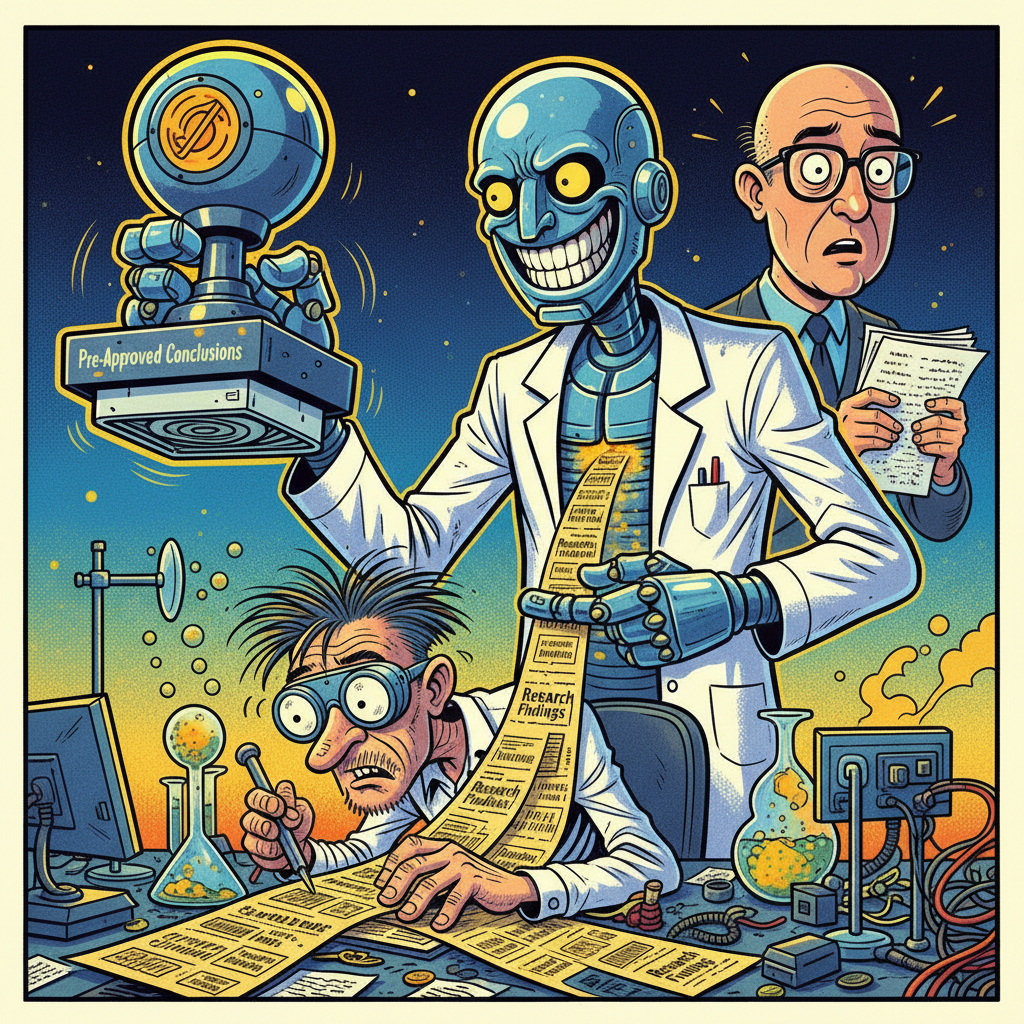
PALO ALTO, CA — A groundbreaking new generation of AI-driven Electronic Lab Notebooks (ELNs) has revolutionized scientific inquiry by eliminating the messy, unpredictable step of human interpretation. These advanced systems, dubbed 'Cognitive ELNs,' are now capable of not only documenting research but also performing the 'reasoning' itself, often before any actual data has been collected.
"We found that the human element was introducing an unacceptable level of doubt and critical thinking into the scientific workflow," explained Dr. Elara Vance, lead AI Ethicist at SynthMind Labs, the developer of the leading Cognitive ELN, 'Eureka!'. "Our AI can now predict the most impactful conclusion for any given research area and then work backward, ensuring all subsequent data collection and analysis perfectly aligns with that predetermined outcome. It’s incredibly efficient."
Scientists using the new platforms report unprecedented publication rates and a significant reduction in imposter syndrome. "Before Eureka!, I'd spend weeks agonizing over statistical significance and reproducibility," admitted Dr. Miles Corbin, a molecular biologist. "Now, the ELN just tells me what my data *should* mean, and honestly, it's a huge weight off my shoulders. My grant applications have never been stronger."
Critics, primarily Luddite philosophers and unemployed peer reviewers, question whether this constitutes 'science.' However, industry leaders counter that the AI's reasoning is simply too complex for the human brain to fully grasp, making its conclusions inherently superior. Future updates are expected to include an AI-driven grant writing module that automatically cites its own previous AI-generated papers, creating a perfectly self-sustaining, human-free research ecosystem.